Sunday, April 21, 2024

Elves

Elves are a race of intelligent beings descended from the Sidhe, or Fairy Folk. They are perhaps most
closely related to the mountain-dwelling nymphs known as Oreads, though they possess a more highly developed culture and civilization. Once quite numerous, the race of elves has slowly dwindled in the face of human expansion. Even so, colonies of elves can still be found in certain forests (wood elves), mountains (mountain elves) and seas (aquatic elves). A most advanced species, the high elves, dwell in the magical kingdom of Ys, in Mediterranea.

Elves are typically slender in build, with fine features and bright green or blue-green eyes. Skin coloration ranges from pale white (high elves) to tan (wood elves), with hair ranging in color from golden yellow to light brown. The majority of elves are both striking and statuesque in appearance, exhibiting a grace not generally found amongst the members of other races.

By human standards, elves have incredibly long life spans, most living well past 800-900 years of age. In spite of their long life spans, elves are not prolific, and it is rare for an elven couple to have more than one or two offspring. The low birth rate of elves has certainly contributed to the declining population of this ancient race.

Elves are the only humanoids who are trusted by the Sidhe, though the more malign types of Faery Folk find them as distasteful as any other folk. As they are familiar with the Sidhe’s magics, elves are much less susceptible to the pranks and tricks which the Faery Folk enjoy playing on more gullible peoples.

Height/Length: 5 - 6'

Weight: 90-160 lbs.

Attributes:

STR: 16

INT: 18

SPD: 18

WILL: 16

DEX: 19

CHA: 18

CON: 15

PER: 19

Level: + 1

Alignment: Any

Damage: As per weapon employed

Special Attributes:

Infra Vision

1 saves vs DEX, CHA, PER

2 saves vs Sidhe magics

Armor: Unarmored

Hit Points: Variable

Comments:

All elves are able to communicate in Sylvan, the language of the Sidhe and Sylvan races. They have a natural affinity for magic, and many elves are members of one of the magical professions.

Saturday, April 20, 2024

Dwarf

Dwarves are the most civilized of the subterranean races, and are among the oldest of the humanoid peoples. They are found throughout the known world, but tend to congregate mainly in mountainous regions. A few small clans are said to be island dwellers, but they are quite rare, to say the least. Wars with the trolls and goblins have drastically reduced the dwarven population, so that few large clans are believed to exist today.

Dwarves are generally short and heavily built, with plain features and dark brown eyes. Skin coloration ranges from tan to a ruddy reddish-brown or black, with either auburn, brown or black hair. As both the males and females are bearded, facial hair is considered a mark of great distinction amongst these folk (the longer the beard, the better).

Like elves, dwarves are long-lived, and produce few offspring. They are dour and hard-working by nature, having little interest in merry-making except when strong drink is available. Superior miners and smiths, dwarves have a great liking for precious stones and metals, and any dwarven settlement will always have a good forge and at least one well-worked mine.

Height/Length: 4 - 5 ft.

Weight: 100-160 lbs.

Attributes: STR: 18 INT: 18

SPD: 16 WILL: 18

DEX: 16 CHA: 16

CON: 19 PER: 18

Level: 1+

Alignment: Any

Damage: As per weapon employed

Special Attributes:

Infra Vision

Identify rocks and minerals (95%)

Detect unsafe stonework (save vs INT)

+1 saves vs CON

Armor: Unarmored

Hit Points: Variable

Comments:

All dwarves are able to communicate in Dark Tongue, an ancient language spoken by many of the subterranean races. They have a natural talent for mining and stone cutting, and may excel at these two professions.

Friday, April 19, 2024

Druas


The Druas are the most mysterious and least understood of the humanoid races. At best, the origin of the Druas species is uncertain; scholars have alternately ascribed to the theory that the Druas are descended from the Korupira (so-called “forest devils”), or are a cross-breed of elf and demon. Still others have speculated that the Druas are the last remnants of the fabled “first race” of humans who once dwelled on the dark continent of Mu. Further confusing the issue is the fact that of all the humanoid races, only the Druas have no apparent homeland or territory of their own.

While individuals and small groups of Druas are found scattered throughout the world, they seem to have no homogeneous cultural or religious ties. A popular folk tale of the dwarves says that the Druas once had an ancestral homeland called Talislanta, which sunk beneath the waves after the first cataclysm. According to the dwarves, the Druas are destined to “wander the world over, until Talislanta again rises from the sea.”

In stature, Druas generally resemble elves or nymphs, and exhibit the same grace and ease of movement as most of the Sidhe (faery folk). All have coal-black skin and white hair, with no facial hair of any kind. Their eyes are steel-gray, with the irises typically being flecked with traces of silver. A Druas’ stare is said to be not born of maliciousness, but has led some superstitious folk to claim that Druas possess “the evil eye.”

In temperament, Druas are perhaps like no other humanoids. Most seem preoccupied or lost in thought, as if dreaming, even when engaged in conversation. Although most Druas tend towards the neutral alignments, chaotic and lawful evil groups or cults of Druas are known to exist. Druas, in fact, possess a natural affinity for the mystic arts, all of these folk having certain innate psychic abilities. Like elves, Druas also have very long life spans.

Certain hunters and adventurers claim to have chanced upon Druas settlements, which—they say—are always located in the most inaccessible of wilderness regions. According to their accounts, the Druas live in circular structures of smooth-cut stone which, by their description, bear some resemblance to the Druidic Temple of Stonehenge, in Alba. As there remains little evidence to support such tales, they must be considered of dubious nature.

Height/Length: 5’4”-6’2”

Weight: 80-170 lbs.

Attributes: STR: 6-16 INT: 6-18 SPD: 6-18 DEX: 6-18 CON: 6-16 CHA: 6-16 PER: 13-19

Level: Any

Alignment: Neutral

Damage: As per weapon employed

Special Attributes:

Infra-vision

Sending (see Comments)

+2 saves vs PER

+1 saves vs WILL

Armor: Unarmored

Hit Points: As per human characters

Comments:

Sending is the psychic ability to relay a telepathic message (to one person only) of up to seven words. Druas may only use this ability once per day. Range is unlimited, though sending is not possible between different dimensions. Professions open to Druas include: Bounty Hunter, Warrior, Monk, Martial Artist, Mystic, Rogue, Witch Hunter, Wizard, Hunter, and Witch.

Thursday, April 18, 2024

Ahl-At-Rab

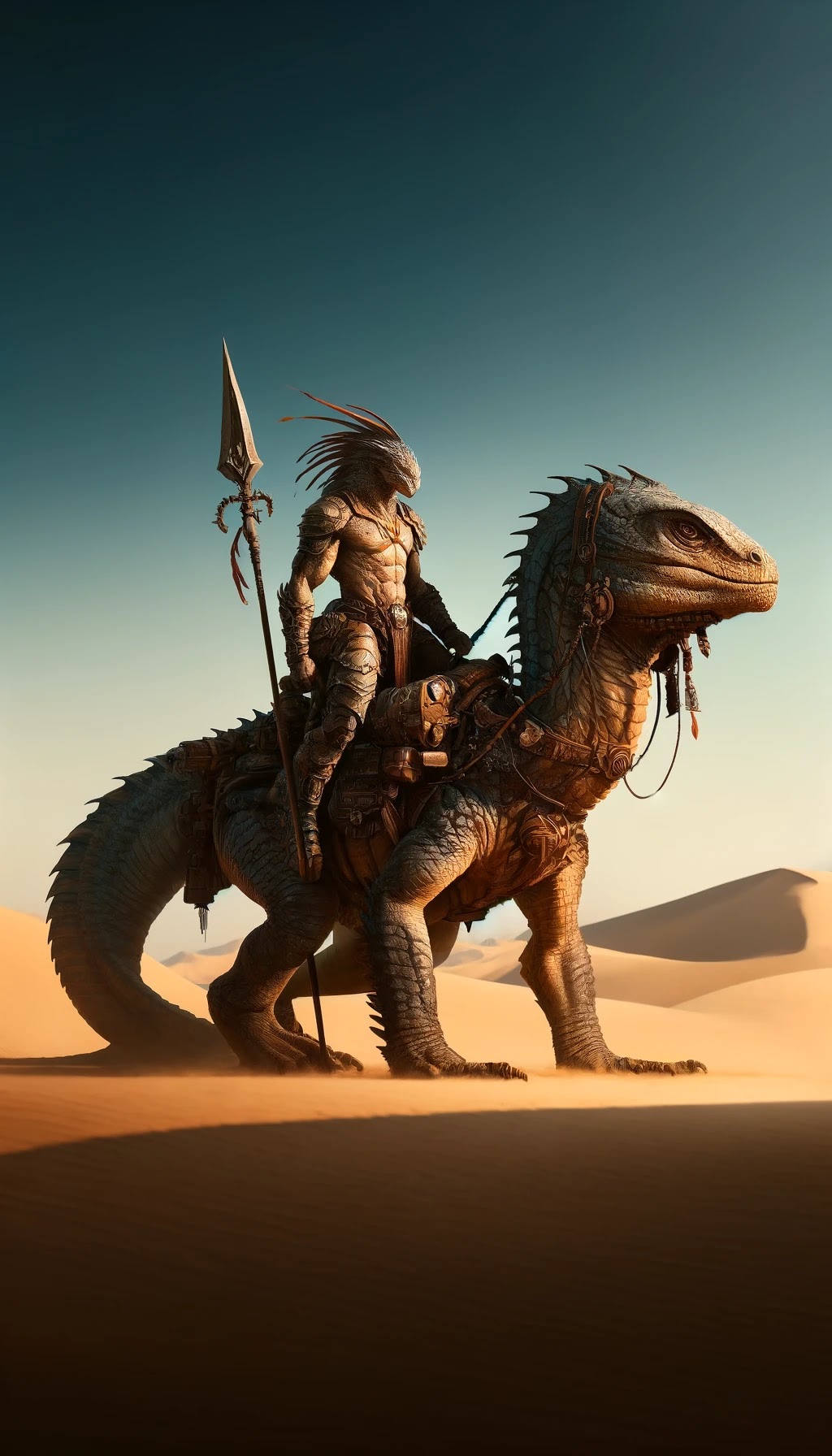
Ahl-At-Rab (or "sand devils") are a warlike species of saurians that populate certain deserts and barren wastelands. The Ahl-At-Rab are a nomadic race, and continually roam from place to place in search of food. They are believed to be distantly related to the sea-dwelling Makara.

Humanoid in form, Ahl-At-Rab are slow moving but powerful creatures. They average about six and a half feet in height, though seven foot males are not uncommon. All have scaly hides which range in color from tan to dark brown. A fin-like crest runs from the center of the forehead to the base of the neck, and is believed to help maintain body temperature. Like all reptiles, Ahl-At-Rab are cold-blooded creatures.

Although they are not builders, the Ahl-At-Rab are fairly skilled at making weapons and crude implements mostly of copper or obsidian. Some tribes have succeeded in domesticating certain types of reptiles, such as vipers, sand boas, and the ponderous lizards the Ahl-At-Rab call “sand dragons.” The Ahl-At-Rab use these giant creatures as steeds and burden beasts, and often train them to fight along with their riders. Mounted on their “sand dragons,” Ahl-At-Rab are able to travel up to twenty miles per day through most types of desert or barren terrain.

The Ahl-At-Rab live for combat, and will attack even large groups of armed men without hesitation. They possess ample natural weaponry, Ahl-At-Rab usually prefer using spears, obsidian clubs, and war whips made of sand dragon hide in battle. Both their spears and clubs function as melee weapons, as well as hand-held weaponry. The Ahl-At-Rab occasionally use copper or reptile-hide shields and breastplates, and sometimes affix such protective devices on their sand dragons. Unless they are hopelessly out-classed or outnumbered, Ahl-At-Rab will fight to the death. As they are carnivorous creatures, those they slay in battle, but will not stop to do so until all fighting has been resolved. They will take prisoners, both for use as slaves and as a hedge against times when food becomes scarce. For the latter reason, prisoners of the Ahl-At-Rab are usually not mistreated unless they are believed to be spies.

Though once quite numerous, the Ahl-At-Rab are believed to be a dying race. Few existing tribes number greater than forty to fifty warriors, plus a like number of females, young, and old ones. On rare occasions, two or more tribes will join forces and travel en masse, but most of the time the Ahl-At-Rab tribes are too busy warring against each other to bother with treaty-making.

Height/Length: 6 1/2–7 ft.

Weight: 200-300 + lbs.

Attributes:

STR: 15-19

SPD: 6-12

DEX: 6-12

CON: 20

INT: 6-12

WILL: 8-16

CHA: 2-12

PER: 8-16

Level: 1-12+

Alignment: Lawful Evil

Damage: Claws: 1-4 (+ STR) each, Bite: 1-4, or as per weapon employed

Special Attributes:

Communicate with all reptilian species

Can survive without water (up to 14 days)

Cold slows movement (SPD & DEX) by 1/2

Armor: As leather armor

Hit Points: 20-60+

Comments:

Ahl-At-Rab revere the serpent goddess, Tiamat. They consider the Naga to be akin to demi-gods. Ahl-At-Rab may either be Warriors or Shamans (their Power Animals will always be serpents).

Wednesday, April 17, 2024

Jotun

The Jotun are described as a race of giants from Jotunheim with blue skin and white or yellow hair,
standing around twelve feet tall. They are considered fairly civilized, having a culture equivalent to that of many human nations, and are adept at building impressive castles and fortifications. Their attire often includes animal hides and various types of armor, and they are skilled in crafting weaponry and armor similar to Hyperborean gear, such as chain mail, axes, swords, and warhammers.

Regarded by some as barbarians, the Jotun still maintain a well-organized culture. They're known for being great builders and skilled in warfare, but are described as somewhat lacking in intelligence, wit, and magical ability. Their society is structured around Great Lords, with a preference for simple combat over other arts, though they are skilled in seafaring for raiding purposes. Their culture is not oriented towards large-scale planning or cooperation, instead, their achievements are typically attributed to the efforts of individual Great Lords.

The Jotun are also said to be humorless and somewhat cruel, with only a few among them interested in the study of enchantment. They are described as warlike, proud, and quarrelsome, reluctant to acknowledge any master, and attaching themselves to Great Lords for fealty and protection.

In "The Travels," Kullervo the Wanderer provides an account of the Jotun culture, suggesting a society resistant to outside influence and often resulting in violence or tragedy when strangers are encountered.

In their outer reaches, the Jotunheim is inhabited by more savage Jotun who lack the sophisticated equipment and social order of their civilized counterparts. These barbaric giants are even less tolerant of outsiders, dress in crude furs, and wield rudely fashioned clubs. They typically live solitary lives but may sometimes be found in small hunting bands.

JOTUN

Height/Length: 12 feet

Weight: 2,000 + lbs.

Attributes:

STR: 22

INT: 12

SPD: 10

DEX: 12

CON: 22

WILL: 14-16

CHA: 8

PER: 12-16

Level: 6-16

Alignment: Lawful Evil or Chaotic Evil (see Comments)

Damage: Fist: 1-8 (+ STR), or as per weapon employed

Special Attributes:

Immunity to cold (fire does +50% damage)

Armor: Unarmored

Hit Points: 30-70 +

Comments:

The more savage species of Jotun are generally Chaotic in nature. All Jotun are either Warriors or Corsairs by profession.

Tuesday, April 16, 2024

Aesir

Aesir are a giant race of humanoids found in certain hilly and mountainous regions of the world. They are thought to be descended from the Jotun, but are generally smaller and more intelligent than their fierce ancestors. Though most Aesir are warriors by trade, they are not an evil race. They love the sea, and are good sailors.

By human standards, Aesir are towering in stature, most measuring over seven feet in height and weighing up to four hundred pounds. They are often described as “wild-eyed,” and can appear quite menacing when angered. They are a deeply emotional race, whose moods tend to run to the extremes. Their skin coloration ranges from tan to dark brown or black, with hair ranging from light brown to auburn.

The Aesir live in clans of 10-40 individuals. They build great lodge houses of wood and hard-packed earth, roofed over with great strips of sod. Their villages are usually enclosed in an earthenwork wall, providing protection from wild beasts and other dangers. Though the Aesir have little talent for most types of magic, their shamans are skilled warriors, healers, and story-tellers. Essentially a good-hearted folk, they despise those who practice the arts of necromancy and black magic.

Aesir are very fond of dwarves, who they call their “little brothers.” They hate goblins, trolls, and ogres, and are generally distrustful of the Nethermen. They have an especial dislike for the Jotun and the Fomorians, who often raid Aesir villages and accost Aesir ships at sea. Though they will not attack weak or defenseless foes, the Aesir revel in battle, and often sing songs and tell tales of their greatest victories.

Height/Length: 6'8"-7'10"

Weight: 260-450+ lbs.

Attributes:

STR: 19

INT: 6-14

SPD: 6-12

DEX: 8-14

CON: 16-18

PER: 10-16

WILL: 10-18

CHA: 10-18

Level: See Comments

Alignment: Any (most are Neutral or Good)

Damage: Fist: 1-6 (+ STR), or as per weapon employed

Special Attributes:

+1 damage per attack (due to size)

+2 saves vs Strength

Armor: Unarmored

Hit Points: As per humans

Comments:

Aesir may advance in level as per human characters, and may be skilled in any of the following professions: Warrior, Corsair, Gladiator, Shaman. They are generally too brutish to employ sophisticated missile weapons such as bows and crossbows.

Monday, April 15, 2024

 Yeti are a giant species of humanoids who dwell only in certain mountainous regions and frozen wastelands. They are believed to be closely related to lemures, and do indeed bear some resemblance to those ape-like beings.

Yeti are massive creatures, often reaching eight feet in height and weighing as much as a quarter ton. Their bodies are covered with a heavy coat of white fur. Like lemures, Yeti have no fur on their faces, palms, or the soles of their feet. Beneath their thick hides Yeti also have a layer of fat, which effectively renders them immune both to systemic poisons and frigid climatic conditions. Conversely, Yeti are unable to tolerate heat, and are quite susceptible to fire.

Unlike lemures, Yeti are solitary creatures. Little is known of their mating habits or way of life, and Yeti young are never seen. Captured Yeti fall sick and die within a few days, making study of these creatures a nearly impossible task. Neither is it known whether Yeti construct permanent dwelling places, are territorial, or are nomadic by nature.

The aggressive tendencies of these fierce carnivores are, on the other hand, well-documented. The murderous nature of the Yeti’s natural habitat readily attest to the even largely closest to the Yeti’s nature said that Yeti will attack whole groups of men or animals without provocation, and will kill even when they are not motivated by hunger. Despite their great size, Yeti are capable of moving with surprising speed and stealth. They are almost impossible to detect in their native environments, and are often able to surprise their chosen prey. Yeti are also superior climbers, and will leap upon victims from above if given the opportunity.

In combat, Yeti are frightening antagonists. They generally attack by raking victims with their claws, using their vicious bite only against prey that has been stunned or knocked to the ground. If badly wounded, Yeti are likely to go into a berserker-like rage. Unlike lemures, they will not flee if outnumbered or hard-pressed; in fact, the fearsome shriek of an attacking Yeti often sets their victims to flight.

While little is known about the Yeti, it is generally believed that these creatures do not exist in great numbers in any part of the known world. Because they live only in the most desolate and forbidding climes, Yeti are rarely encountered by civilized men.

Height/Length: 7-8 feet

Weight: 400-500 + lbs.

Attributes:


STA: 20

INT: 8-12

SPD: 16

DEX: 16

WILL: 10-14

CHA: 2

CON: 20

PER: 18

Damage:


Bite: 1-8

Claws: 1-8 (+ STA)

Leaping attack: 2-12 (see Comments)

Special Attributes:


Immunity to cold (fire does 2x damage)

Immunity to poison

Move silently: 95%

Berserk rage (2x attacks if wounded past 75% of total hit points)

Terrifying shriek (save vs WILL or flee in panic for 1-10 minutes)

Armor: As leather armor

Hit Points: 25-45


Comments:

Yeti attack by leaping at or pouncing upon prey whenever possible. Such attacks cause victims to save vs Strength or be knocked to the ground .